Why x402 changes API monetization
For years, building an API meant wrestling with authentication keys, subscription tiers, and manual billing. AI agents cannot sign credit card forms or manage Stripe accounts. x402 removes this friction by turning every API endpoint into a payment gateway. It is an open, neutral standard for internet-native payments that allows AI agents to pay for data without human intervention.
The protocol works by requiring a payment for HTTP access. When an agent requests data, the server responds with a 402 status code and a payment instruction. The agent pays using a stablecoin, and the server immediately grants access. This creates a seamless loop where payment and data delivery are locked together.
This shift is critical for chain analytics. Providers can now charge per-request for high-frequency data streams, such as real-time block states or transaction traces. Agents can budget their compute costs directly, paying only for the specific analytics queries they need. This transforms API monetization from a static subscription model into a dynamic, usage-based economy.
By embedding payment logic into the HTTP protocol itself, x402 creates a unified layer for agent commerce. It does not rely on legacy banking rails or third-party payment processors. Instead, it uses the blockchain as a neutral settlement layer, ensuring that every transaction is verifiable and instantaneous.
How x402 V2 simplifies multi-chain payments
The original x402 standard established a baseline for machine-to-machine commerce, but it was constrained by its reliance on specific blockchain environments. x402 V2 removes these artificial boundaries, allowing agents to transact across a fragmented crypto landscape without requiring custom integration code for every new network. This standardization is critical for chain analytics APIs, where data sources and payment providers may operate on entirely different ledgers.
At its core, V2 introduces a unified payment format that abstracts away the underlying chain differences. Whether a buyer holds USDC on Base, Solana, or an emerging Layer 2, the protocol handles the routing and settlement uniformly. This means an analytics provider can expose a single API endpoint that accepts payments from any compatible wallet, regardless of the asset's origin. The result is a frictionless experience where the complexity of cross-chain bridges is hidden from both the developer and the end-user.
This multi-chain capability transforms how data is monetized. Instead of maintaining separate payment gateways for Ethereum, Polygon, and Solana, agents can access any data feed using their preferred stablecoin. The protocol ensures that the value transferred is consistent, even if the gas costs and finality times vary across networks. By standardizing these interactions, x402 V2 enables a true global market for data, where liquidity is not trapped within isolated silos.
To understand the economic context of these transactions, it is helpful to look at the primary asset used for settlement: USDC. As the dominant stablecoin for API payments, its price stability and wide availability across chains make it the ideal medium of exchange for x402 integrations.
Leading providers using x402 for analytics
The x402 standard is moving beyond theory as several major chain analytics platforms integrate it into their core infrastructure. These providers are demonstrating how to monetize on-chain intelligence directly to AI agents without relying on traditional subscription models or human-in-the-loop payment verification. By adopting x402, these platforms are enabling programmatic access to high-value data, allowing agents to pay per request for real-time blockchain insights.
Nansen has integrated x402 to monetize access to its blockchain analytics platform. This integration allows AI agents and developers to pay for on-chain intelligence and wallet labels directly, streamlining the workflow for those who need detailed token and address analytics. Similarly, Bitquery has released comprehensive documentation on its x402 Data API, showing how developers can access payment transactions and monitor server activity in real-time. Their approach emphasizes the ability to analyze payment analytics alongside the data itself, providing a complete view of on-chain economic activity.
On the more specialized end of the spectrum, Allium uses x402 to enable AI agents to make per-request stablecoin payments. This model removes the need for human intervention, allowing for the scaling of programmatic workflows that require granular, token-level data. For niche use cases, PulseChain offers a blockchain analytics API with 28 x402-paid endpoints. These endpoints cover token safety scores, opportunity signals, and whale alerts, demonstrating how x402 can be applied to smaller, highly specific data sets.
The following comparison highlights how these providers differ in their data focus and chain support, illustrating the diverse applications of x402 in the analytics space.
| Provider | Data Focus | Supported Chains | Integration Type |
|---|---|---|---|
| Nansen | Wallet labels and smart money tracking | Multi-chain | Platform monetization |
| Bitquery | Payment transactions and server analytics | Multi-chain | Data API |
| Allium | Granular token-level data | Multi-chain | Per-request stablecoin payments |
| PulseChain | Token safety and whale alerts | PulseChain | 28 paid endpoints |
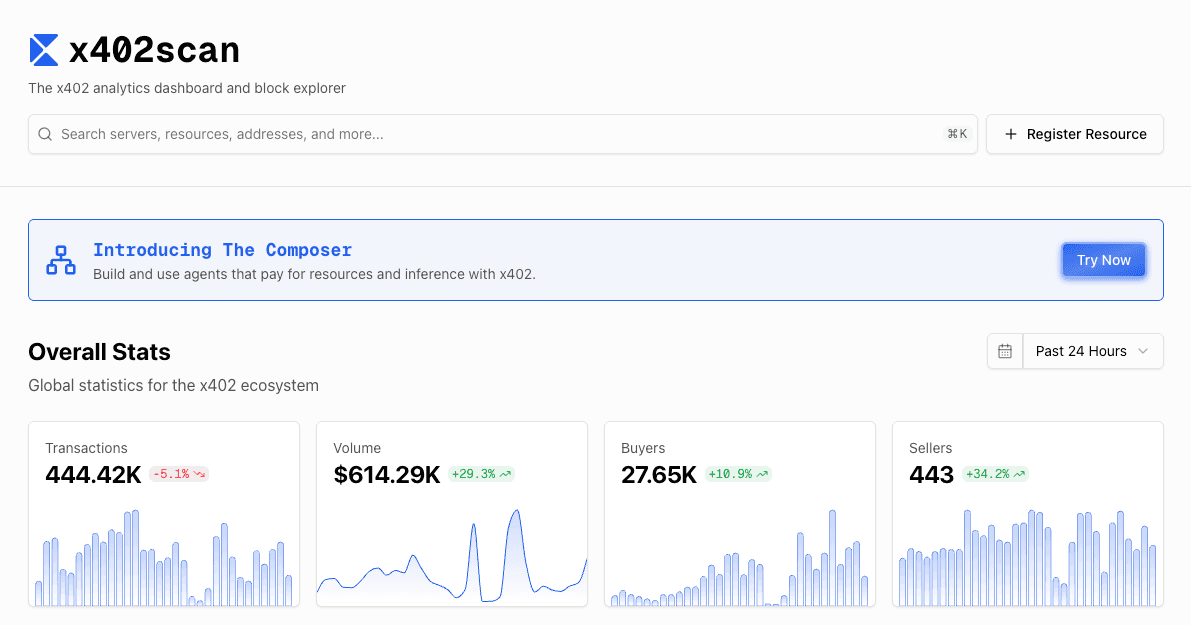
This shift toward x402-enabled endpoints is creating a new economy for chain data. Instead of relying on static datasets, agents can now access live, verified information by paying directly at the point of use. This model not only generates revenue for data providers but also ensures that agents receive the most current and accurate on-chain intelligence available.
Integrating x402 into your API workflow
Adding x402 to an existing API requires minimal changes to your server logic. The standard approach involves intercepting incoming requests, validating the Paywall-Receipt header, and returning a 402 status if payment is missing. For developers, the easiest entry point is using a facilitator like Thirdweb, which handles the complex on-chain verification of USDC payments. You can follow the official Coinbase Developer documentation to see how sellers structure these endpoints.
Start by creating a wallet to receive payments and signing the facilitator’s smart contract. Thirdweb’s x402 facilitator provides a ready-to-use contract that verifies receipts on-chain, removing the need to write custom verification logic. This setup acts as the gatekeeper for your API endpoints.
Modify your API routes to look for the Paywall-Receipt header. If the header is absent, return a 402 Payment Required status along with the facilitator’s verification URL. This tells the client exactly where to send the payment before the API processes the actual request.
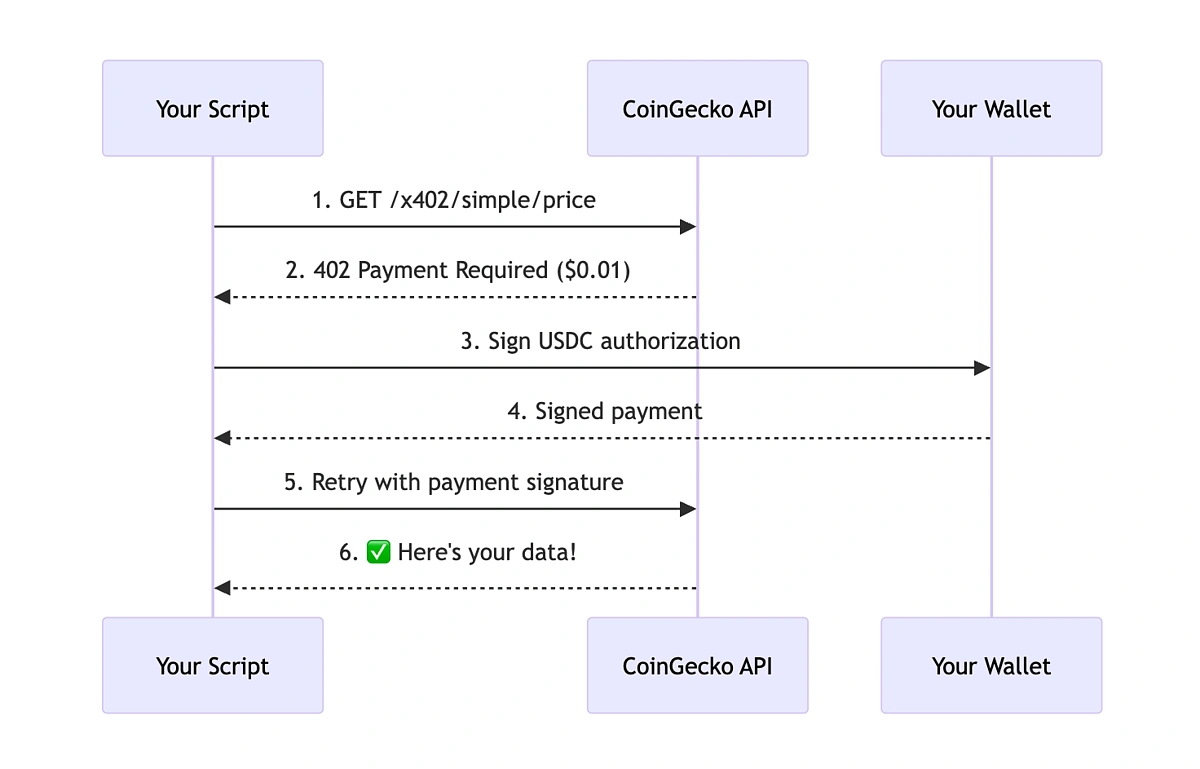
Use a test agent or curl command to verify the flow. Send a request without a receipt to confirm the 402 response, then send one with a valid receipt to ensure the API returns the expected data. This step ensures your chain analytics or data endpoints are properly secured.
Common questions about x402 payments
The x402 protocol is reshaping how AI agents and servers transact. Below are answers to the most frequent questions about how it works, its evolution, and the broader ecosystem.
No comments yet. Be the first to share your thoughts!