Why x402 matters for data providers
The traditional model for accessing on-chain analytics relies on API keys and monthly subscriptions. This creates friction for AI agents, which cannot manage recurring billing. x402 solves this by moving payments to the protocol layer, enabling pay-per-use micro-transactions.
For analytics providers, this shift allows monetization of long-tail queries that were previously too small to justify administrative overhead. The protocol is chain-agnostic, working with any blockchain that supports smart contracts. By embedding payment logic into the HTTP response, x402 removes the need for third-party processors.
This approach aligns with autonomous agent commerce. AI agents can programmatically pay for data without human intervention, scaling workflows that were previously limited by manual API calls. For data providers, this opens a new market of machine-to-machine transactions.
How x402 endpoints work in practice
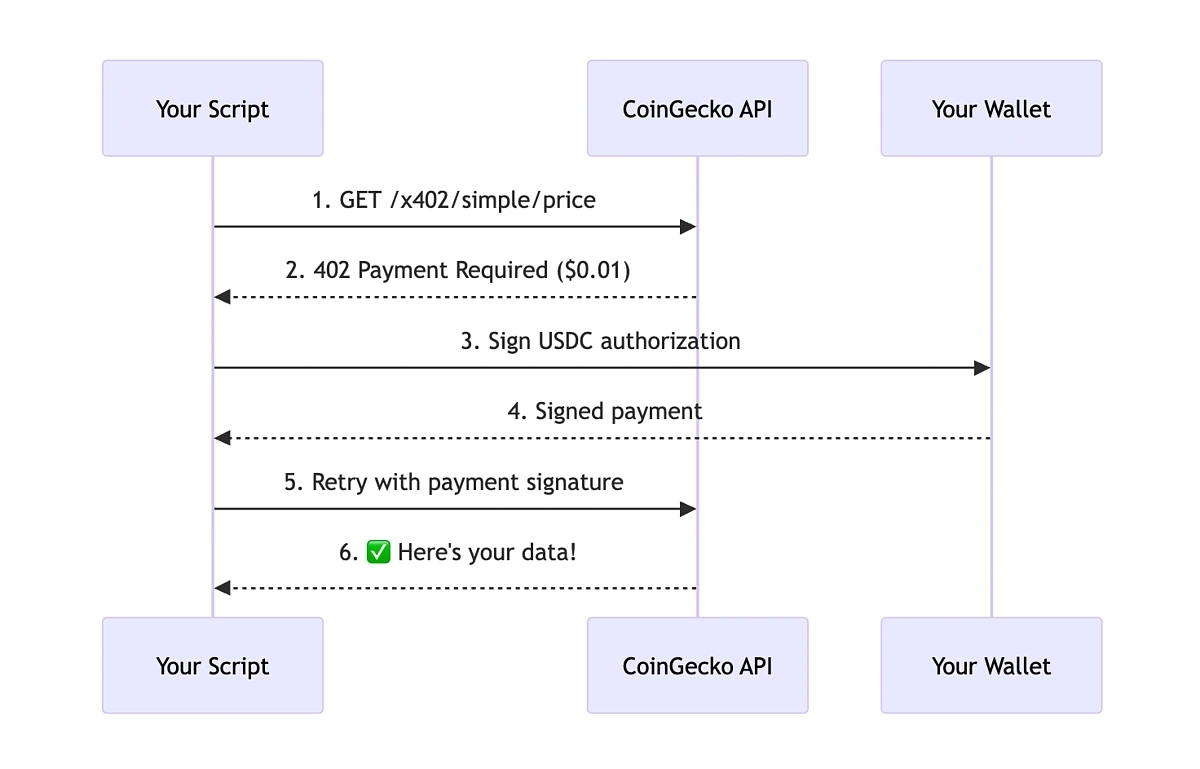
An x402 endpoint functions as a payment-gated API. Instead of relying on credit card processors, these endpoints return a standard HTTP 402 (Payment Required) response when a request lacks valid payment credentials. This response includes a payload detailing how to pay.
The mechanism involves a three-party flow: the client, the facilitator, and the on-chain network. The 402 response embeds payment instructions, including the destination wallet, required token (typically USDC), and exact amount. This moves payment logic from a centralized database to the blockchain.
The payment flow
- Request initiation: A client calls your endpoint.
- 402 response: The server returns a 402 status with a payment payload.
- Facilitator involvement: The client uses an x402 facilitator to construct and sign the transaction.
- On-chain settlement: The facilitator submits the transaction. Once confirmed, it returns a proof of payment.
- Access granted: The client resends the request with the payment proof. The server verifies the transaction and returns the data.
This flow ensures atomicity. The facilitator handles signing and submission, keeping your API logic clean.
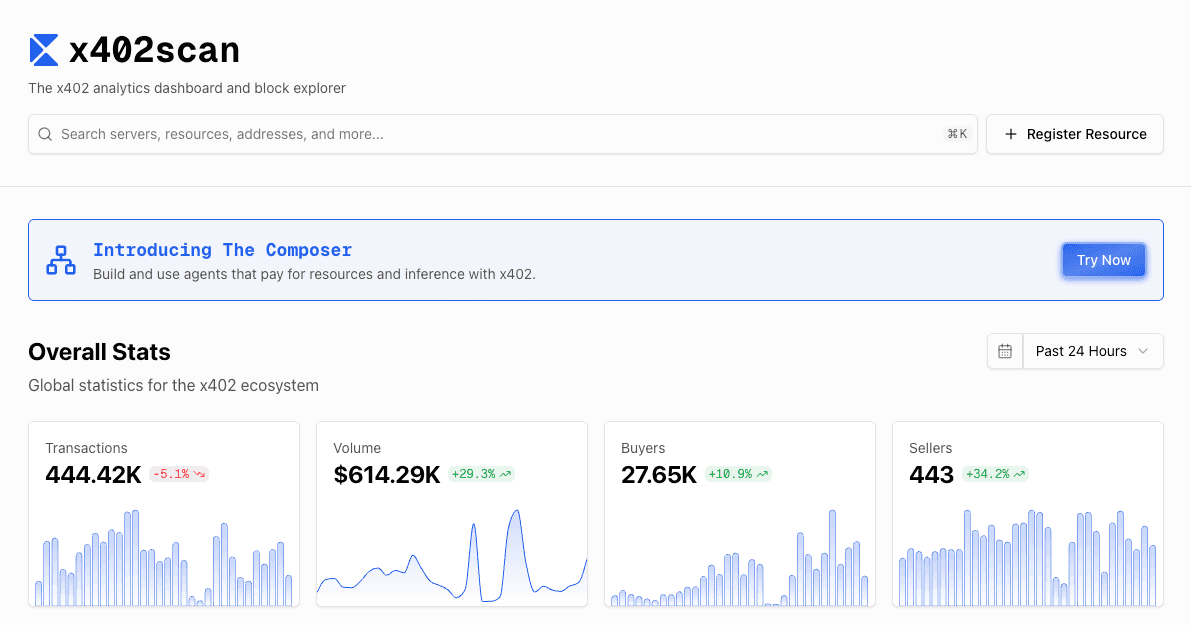
Your API checks for valid payment credentials. If none are present, it returns a 402 status code with a JSON payload containing payment details, including recipient address, token contract, and amount.
The client uses an x402 facilitator library to read the 402 payload and create a signed transaction for the specified token transfer. This happens locally on the client side, often within an AI agent’s execution loop.
The facilitator broadcasts the transaction to the blockchain. Once confirmed, it generates a cryptographic proof of payment, which the client sends back to your API.
Your API receives the payment proof and verifies the transaction hash against the blockchain. If valid, it returns the requested data. If not, it returns the 402 again.
Stablecoins like USDC are critical for this model. Because their value is pegged to the dollar, you avoid price volatility between initiation and settlement, making x402 endpoints practical for real-time data pricing.
Why the facilitator matters
You do not need to build a custom wallet or manage private keys on your server. The facilitator abstracts away wallet management, gas fees, and transaction signing. For AI agents, this is essential for autonomous execution. The facilitator handles blockchain interaction, while your API only validates the final proof.
Leading analytics platforms using x402
Major chain analytics providers are deploying x402 endpoints, allowing AI agents and developers to pay per request using stablecoins. This bypasses traditional API key management.
Nansen: On-Chain Intelligence
Nansen has integrated x402 to monetize wallet labeling and smart money tracking data. This enables AI agents to query on-chain intelligence directly, removing the friction of human intervention for high-frequency requests. Agents can pay for specific wallet insights in real time, allowing automated systems to incorporate high-value data into decision-making processes.
Bitquery: Real-Time Payment Analytics
Bitquery leverages x402 to open its data API to programmable commerce. Developers can access payment transactions and monitor server activity using per-request stablecoin payments. This approach is useful for applications needing to verify on-chain events without fixed monthly subscriptions. The x402 endpoint allows granular access, meaning users only pay for specific data points retrieved.
Allium: Agent-Ready Data Streams
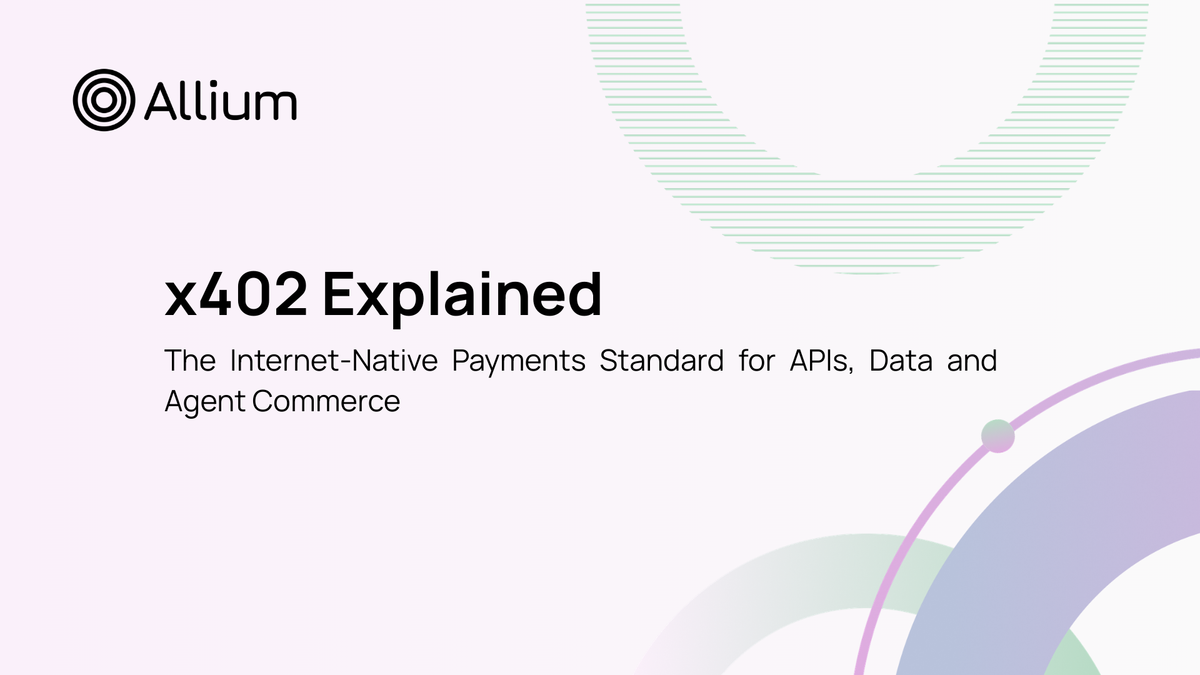
Allium positions x402 as a key enabler for agent commerce. Their implementation focuses on enabling AI agents to make per-request stablecoin payments, scaling programmatic workflows. By removing API keys and account setups, Allium’s endpoints allow agents to fetch clean, structured blockchain data on demand. This is critical for agents reacting to on-chain events in milliseconds, as payment and data delivery happen in a single atomic step.
Feature Comparison
| Provider | Primary Data Focus | Agent Compatibility |
|---|---|---|
| Nansen | Wallet labeling, smart money tracking | High - Supports automated wallet queries |
| Bitquery | Transaction history, payment analytics | High - Real-time event monitoring |
| Allium | Clean, structured blockchain data | High - Atomic payment and data delivery |
Implementing x402 for your API
Turning your chain analytics endpoint into a paid service requires bridging standard HTTP requests with on-chain settlements. The x402 specification treats payments as a standard HTTP header, allowing you to keep your existing API structure while adding a payment layer.
1. Choose a facilitator
Using a facilitator is significantly faster and more reliable than handling cryptographic verification yourself. Thirdweb provides an x402 facilitator that integrates directly with Next.js. Alternatively, Coinbase CDP offers a dedicated quickstart for sellers that abstracts away blockchain interaction.
2. Configure 402 headers
Your API must recognize the 402 Payment Required status code. When a request arrives without a valid payment signature, return a 402 response with a Pay-URL header pointing to the payment gateway. Once the buyer pays, they receive a cryptographic signature to attach to the Authorization header of their next request. Your server validates this signature against the facilitator's verification endpoint.
3. Test with a wallet
Verify your payment flow end-to-end using a testnet environment. Thirdweb and Coinbase provide testnet configurations to simulate transactions without risking real funds. Ensure your API correctly rejects requests with invalid or expired signatures and accepts valid ones.
4. Deploy and monitor
Deploy your API to production with mainnet support. Enable robust rate limiting and access controls. Monitor 402 response rates to understand how many requests are gated by payment, helping you adjust pricing or improve your API's value proposition.
Select a facilitator like Thirdweb or Coinbase CDP to handle cryptographic verification and settlement logic.
Set your API to return a 402 Payment Required status with a Pay-URL header when no valid signature is present.
Use testnet environments to simulate transactions, ensuring your API correctly validates signatures before going live.
Enable mainnet support, monitor 402 response rates, and track transaction fees to maintain a profitable revenue model.
Market implications for agent commerce
x402 shifts on-chain data from a static resource to a liquid, programmable asset. By embedding payment logic directly into API endpoints, this standard allows AI agents to execute micro-transactions without human approval. This removes the friction of traditional billing cycles, enabling a high-frequency economy where data is consumed and compensated in real time.
Stablecoins serve as the ideal settlement layer. Because their value remains pegged to fiat currencies, developers and data providers avoid the volatility risk that often deters enterprise adoption. The stability ensures that a query for blockchain analytics costs the same amount regardless of market swings, making automated budgeting predictable for AI workflows.
This architecture is reshaping how analytics firms operate. Platforms like Nansen are integrating x402 to monetize access to on-chain intelligence, allowing agents to pay per request for wallet tracking. Similarly, providers like Allium are leveraging the standard to scale programmatic workflows, where agents fetch historical data or real-time signals without manual intervention.
The broader economic impact is the creation of a self-sustaining data market. Instead of relying on subscription models, data creators can monetize every individual query. This lowers the barrier to entry for developers needing specific insights, while providing data providers with a scalable, automated revenue stream that grows with usage.
No comments yet. Be the first to share your thoughts!