
What x402 changes for analytics data
Accessing high-quality blockchain analytics has historically required API keys, signed contracts, and monthly subscriptions. x402 flips this model by introducing an HTTP-native payment protocol that allows AI agents to pay for data per request using stablecoins. This removes the friction of human intervention, enabling seamless machine-to-machine commerce.
This shift is critical for the growing ecosystem of autonomous AI agents. These agents don't have bank accounts or credit cards, but they do have digital wallets. By integrating x402, analytics providers like Nansen and Allium are allowing agents to query complex on-chain data programmatically. The agent sends a request, the server responds with a payment instruction, the agent pays in stablecoins, and the data is delivered instantly. This creates a scalable, permissionless marketplace for data.
The implications for chain analytics are significant. Instead of paying for a flat monthly fee that might go unused, you only pay for the specific data points you need. This micro-transaction model aligns costs with actual usage, making it feasible for smaller projects and individual developers to access institutional-grade analytics without long-term commitments.
How the payment flow works
The x402 protocol turns a standard API call into a transaction. Instead of relying on pre-funded API keys or credit card subscriptions, the client pays only when it requests data. This mechanism is particularly useful for chain analytics APIs, where usage can be sporadic and unpredictable.
The process begins when your client sends a standard HTTP request to the endpoint. The server recognizes the request as requiring payment and responds with a 402 Payment Required status code. This response isn't an error; it's a receipt request. The response body contains a Facilitator header with a URL to a payment facilitator service.
The client then uses this facilitator URL to initiate a payment, typically in a stablecoin like USDC. The facilitator handles the blockchain transaction, ensuring the funds are transferred from the client to the API provider. Once the transaction is confirmed on-chain, the facilitator sends a signed receipt back to the client.
The client includes this receipt in a subsequent request to the original endpoint. The server verifies the receipt's signature and validity. If everything checks out, the server returns the data. This flow ensures that payment precedes access, eliminating the risk of non-payment for the provider.
To understand the economic context of these transactions, it helps to look at the underlying asset. Most x402 implementations use stablecoins to avoid volatility during the brief window between payment and data retrieval.
This flow creates a trustless environment where the provider doesn't need to trust the client to pay later, and the client doesn't need to trust the provider to deliver data after payment. The blockchain serves as the neutral arbiter, recording every transaction immutably.
Leading chain analytics using x402
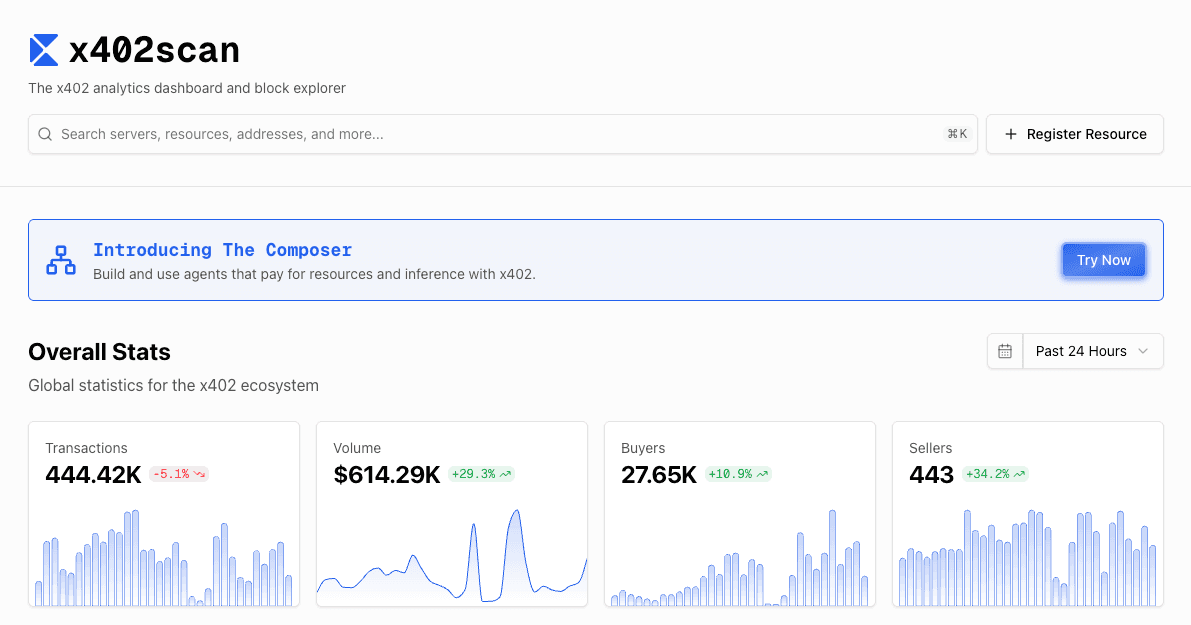
The x402 protocol is moving from concept to infrastructure, with major chain analytics providers already integrating the standard. This adoption signals a shift toward automated, machine-to-machine payment models for blockchain data. Platforms like Nansen, Bitquery, and Allium are demonstrating how x402 can streamline access to on-chain intelligence for AI agents and developers.
Nansen has implemented x402 to monetize its blockchain analytics platform. By adopting this standard, Nansen allows developers and AI agents to pay for wallet tracking and smart money insights using stablecoins without manual invoicing. This integration removes friction for users who need real-time on-chain data to inform trading or security decisions.
Bitquery offers a comprehensive suite of data APIs that now support x402 payments. Their documentation highlights how the protocol enables seamless access to payment transactions and server activity monitoring. For projects requiring deep historical data or real-time blockchain indexing, Bitquery’s x402 integration provides a programmable way to settle fees per request.
Allium focuses on high-quality, normalized blockchain data and has integrated x402 to support AI agent commerce. Their approach emphasizes per-request stablecoin payments, which scales programmatic workflows by removing human intervention from the billing process. This is particularly useful for AI applications that need to query large datasets frequently.
The following table compares these leading providers based on their data focus, supported chains, and x402 integration status.
| Provider | Data Focus | Supported Chains | x402 Status |
|---|---|---|---|
| Nansen | Wallet tracking & smart money | Multi-chain | Integrated |
| Bitquery | Historical & real-time indexing | Multi-chain | Integrated |
| Allium | Normalized data for AI | Multi-chain | Integrated |
Build an x402-enabled API
Turning your chain analytics API into an x402 endpoint shifts how you handle payments. Instead of managing API keys, subscriptions, or user accounts, you let the HTTP 402 status code handle the transaction. This approach is particularly powerful for AI agents and automated services that need to pay for data without human intervention.
The implementation relies on standard HTTP responses. When a client requests data, your server checks for payment. If unpaid, it returns a 402 status with a payment link. Once the payment clears on-chain, the client receives the data. This eliminates the friction of traditional payment gateways for machine-to-machine interactions.
1. Choose a Facilitator
You don't need to build the payment infrastructure from scratch. Use an existing facilitator like Thirdweb or the Coinbase Developer Platform (CDP). These tools handle the complex on-chain logic, allowing you to focus on your API's core functionality. The Coinbase CDP offers a dedicated quickstart for sellers, making it a strong choice for developers already in the Ethereum ecosystem Coinbase CDP x402 Guide.
2. Configure 402 Responses
Your API needs to be configured to recognize unpaid requests. When a request comes in without a valid payment, return an HTTP 402 status code. Include a PaymentLink header that directs the client to a payment page or smart contract interaction. This header tells the client exactly how to pay to access the data. Quicknode provides a clear guide on how to structure these responses for their endpoints Quicknode x402 Guide.
3. Test with USDC
Before going live, test your endpoint with a small amount of USDC on a testnet. Verify that the payment link works and that the data is only delivered after the transaction is confirmed. This step ensures that your payment logic is robust and that clients can successfully interact with your API.
4. Deploy to Production
Once testing is complete, deploy your x402-enabled API to production. Monitor the first few transactions to ensure everything is working as expected. You can now start accepting payments for your chain analytics data directly through your API.
Use Thirdweb or Coinbase CDP to handle on-chain payment logic.
Return HTTP 402 with a PaymentLink header for unpaid requests.
Verify payment flow and data delivery on a testnet.
Launch your API and monitor initial transactions.
FAQs on agent-commerce payments
When integrating x402 endpoints for chain analytics, developers often encounter specific questions about how the protocol handles latency, currency, and errors. Here are the most common technical inquiries.
How does x402 handle transaction latency?
x402 transactions rely on on-chain confirmations, which introduces a slight delay compared to traditional API key validation. The server returns a 402 Payment Required status, prompting the client to sign and broadcast a transaction. For EVM-compatible chains like Ethereum or Base, finality typically takes a few seconds to minutes depending on network congestion. During this window, the client must poll the endpoint or wait for the blockchain receipt before retrying the original request.
Which currencies are supported for payments?
The x402 protocol is chain-agnostic but requires the payment currency to match the underlying blockchain. On Ethereum and Base, payments are made in ETH or stablecoins like USDC. Since x402 is an open HTTP payment protocol, it replaces API keys with on-chain proofs of payment, meaning you do not need a separate billing account or credit card on file with the API provider. The currency is determined by the smart contract or payment gateway configured on the endpoint.
How are payment errors handled?
Error handling in x402 is explicit. If a transaction is underpaid, expired, or sent to the wrong address, the server returns a 402 status with a detailed error message explaining the failure. This allows the client application to automatically retry with the correct amount or address. Unlike traditional APIs that might return generic 401 Unauthorized errors, x402 provides clear feedback on the payment state, reducing ambiguity during debugging.
No comments yet. Be the first to share your thoughts!