What x402 changes for data sellers
The traditional API economy relies on a brittle trust model: static API keys. You issue a key, hope the client doesn't share it, and manually revoke it if they stop paying. x402 replaces this friction with on-chain payment verification, allowing data sellers to accept direct USDC payments for every request. This shift moves the burden of payment enforcement from your backend code to the blockchain, creating a system where access is granted only when the transaction settles.
For AI agents, this is the missing link. An agent cannot hold a secret API key in a persistent, secure way without complex infrastructure. Instead, an agent can hold a wallet and a small balance of USDC. When it needs data, it pays the endpoint directly. This enables true pay-per-use commerce at machine speed, turning your API into a self-sovereign service that doesn't require user accounts or subscriptions.
x402 replaces static API keys with dynamic, on-chain payment verification, enabling pay-per-use models for AI agents.
The economic model shifts from "access control" to "transaction settlement." You no longer need to manage churn or billing cycles. If the payment fails, the data is not returned. This simplicity lowers the barrier for small data providers to monetize niche datasets, as they can integrate x402 support without building a full billing platform. The result is a more liquid market for data, where supply and demand are matched in real-time via smart contracts.
To understand the economic viability, consider the cost of a single API call. With x402, you can set micro-prices that are economically feasible due to low gas fees on L2 networks.
Key endpoints in the x402 ecosystem
The x402 protocol is moving from theory to production, with major infrastructure providers and analytics platforms building native support into their endpoints. This shift allows AI agents and developers to pay for data and compute on-chain, removing the friction of API keys and pre-funded wallets.
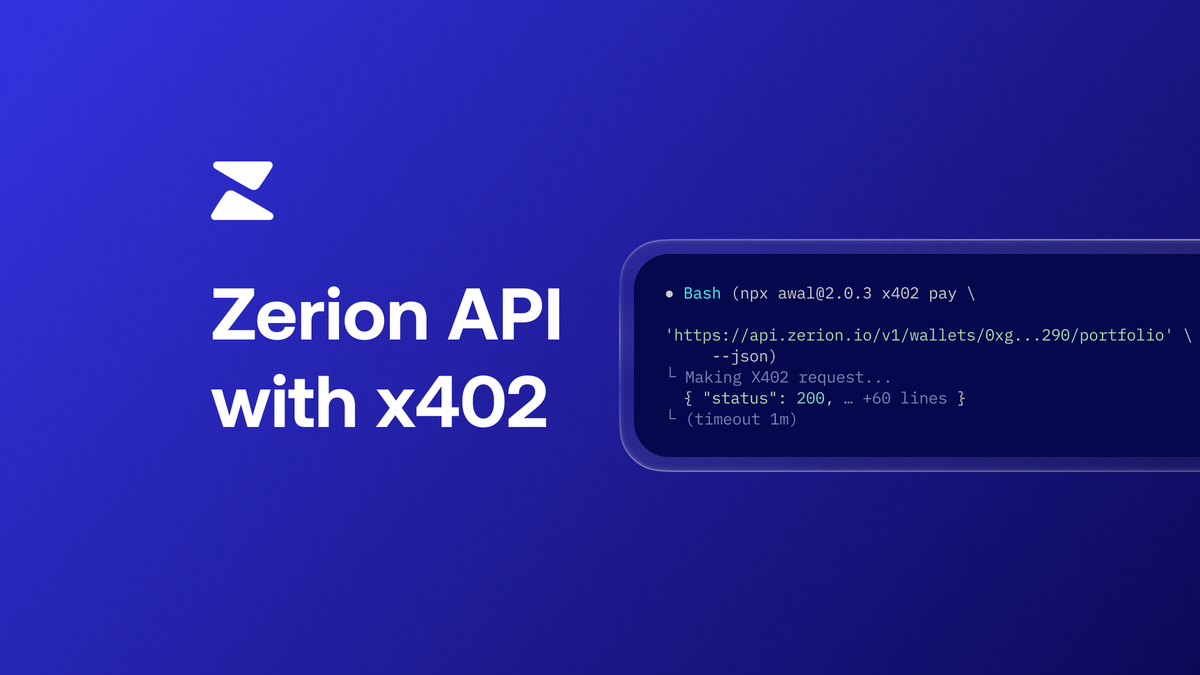
Major players are implementing this model differently. Some, like Coinbase CDP, are enabling sellers to accept payments for their existing services. Others, like Bitquery and Nansen, are structuring their entire data access around microtransactions. Quicknode is focusing on the infrastructure layer, allowing node access without traditional subscriptions.
The following table compares how these providers are currently handling x402 integration, highlighting the differences in supported chains, data types, and access models.
| Provider | Primary Focus | Supported Chains | Access Model |
|---|---|---|---|
| Coinbase CDP | Seller Integration | Multi-chain | Pay-per-use API |
| Bitquery | Data Analytics | EVM & Non-EVM | Token-gated Queries |
| Nansen | On-chain Intelligence | EVM | Microtransactions |
| Quicknode | Node Infrastructure | Multi-chain | No-key Access |
The trend is clear: the barrier to entry for high-quality blockchain data is lowering. Instead of negotiating enterprise contracts, developers can now access real-time analytics and node infrastructure by simply holding or spending crypto. This aligns with the broader goal of x402 to make AI agents autonomous economic actors.
For context on the underlying asset often used in these transactions, here is the current market data for USDC, the primary stablecoin facilitating these micro-payments.
How the payment flow works
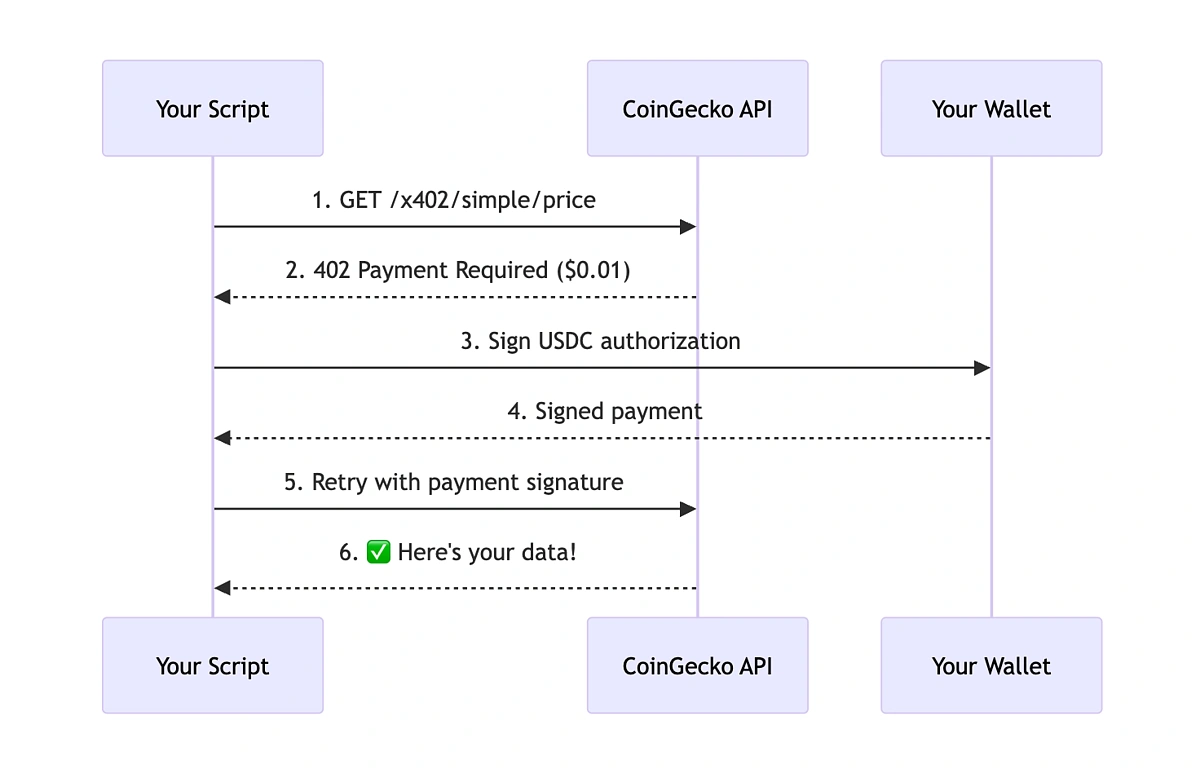
The x402 protocol turns standard HTTP endpoints into programmable paywalls. Instead of relying on credit card processors or complex OAuth tokens, the exchange happens directly between the client, the server, and a Facilitator. This mechanism allows AI agents and software clients to pay for data or compute power using stablecoins, typically USDC, with atomic finality.
The process follows a strict four-step handshake. Each step relies on specific HTTP headers to negotiate the price, verify the payment, and deliver the payload. Understanding this flow is essential for building APIs that can accept onchain payments without leaving the web2 stack.
The client sends a standard HTTP GET request to the API endpoint. At this stage, no payment has been made. The server responds with a 402 Payment Required status code, signaling that access is gated. Crucially, the response includes a Paywall header containing the price, the currency (e.g., USDC), and the blockchain network details. This header tells the client exactly what is needed to access the data.
The client wallet constructs a transaction to send the specified amount of stablecoins to the server’s designated address. Once the transaction is broadcast to the blockchain, the client receives a transaction hash (txid). The client then attaches this txid to a new HTTP request, often using a Authorization or custom x-payment header, and sends it back to the server. This step proves intent and provides the reference for verification.
The server does not check the blockchain directly. Instead, it forwards the txid to a Facilitator (a specialized infrastructure provider). The Facilitator monitors the blockchain for confirmation of the payment. Once the transaction is confirmed and the funds are settled, the Facilitator returns a signed cryptographic proof (a signature) to the server. This signature serves as an immutable receipt that the payment was valid.
Upon verifying the Facilitator’s signature, the server grants access. It returns a 200 OK status code along with the requested data payload. The entire exchange is atomic: the client receives the data only after the payment is irrevocably confirmed. This eliminates chargeback risks and allows for microtransactions that are impossible with traditional payment rails.
This flow decouples payment from identity. Because the verification is handled by the Facilitator and the blockchain, the server only needs to validate the signature. This architecture is particularly powerful for Chain Analytics APIs, where high-frequency data access can be monetized seamlessly without manual invoicing or subscription management overhead.
Integrating x402 into your API
Adding x402 support to your chain analytics API doesn't require a complete rewrite. The protocol is designed to sit alongside your existing logic, letting you charge for data access or compute without changing how clients interact with your endpoints. You can start with a simple middleware layer and expand to full agent support as needed.
The most straightforward path is using an official SDK. For Node.js environments, the x402-express package provides a ready-made middleware that validates payments before your route handler runs. This keeps your business logic clean while handling the cryptographic verification of the payment proof.
import { x402Middleware } from 'x402-express';

app.use('/api/analytics', x402Middleware({
  currency: 'USDC',
  amount: '0.01', // 1 cent per request
  callback: async (proof) => {
    // Verify proof and proceed
    return true;
  }
}));
If you're building for AI agents, ensure your API returns the x-payments header. This signals to agents like those built on the Coinbase CDP that your endpoint accepts x402 payments. Without this header, agents may skip your API entirely, even if it's technically compatible.
For non-Node environments, the protocol is language-agnostic. You can implement the verification logic in Python, Go, or Rust by following the x402 specification. The core requirement is simple: verify the payment proof attached to the request before returning data.
To ground the economics, here is the current price of USDC. Since x402 transactions are typically micro-payments, even small price fluctuations can impact your revenue model.
Common integration pitfalls
Even with a clean spec, x402 implementations often fail at the edges. The most frequent error is hardcoding a single facilitator URL. If that endpoint goes down or changes, your API stops accepting payments entirely. Treat the facilitator as a transient routing layer, not a permanent dependency.
Payment failures require graceful handling, not silent drops. When a buyer’s wallet lacks sufficient USDC, the API should return a clear 402 Payment Required response with a link to fund the account. This keeps AI agents and users from hitting dead ends.
Use the live USDC price to ground your integration logic.
Always validate the response headers against the x402 standard before processing the payload. Skipping this step leads to mismatched data types and broken agent workflows.
Checklist for launching x402 APIs
Before you push to production, verify your endpoint handles the Payment-Required (402) status code correctly. Your server must accept valid USDC transactions on the designated chain and release the requested data only after confirmation. This prevents unpaid scraping and ensures your API is agent-ready.
Integrate with a facilitator like Coinbase CDP to streamline the payment flow. They handle the wallet interactions and verification, letting you focus on the data logic. Test the endpoint with a small USDC transfer to confirm the response time and error handling.
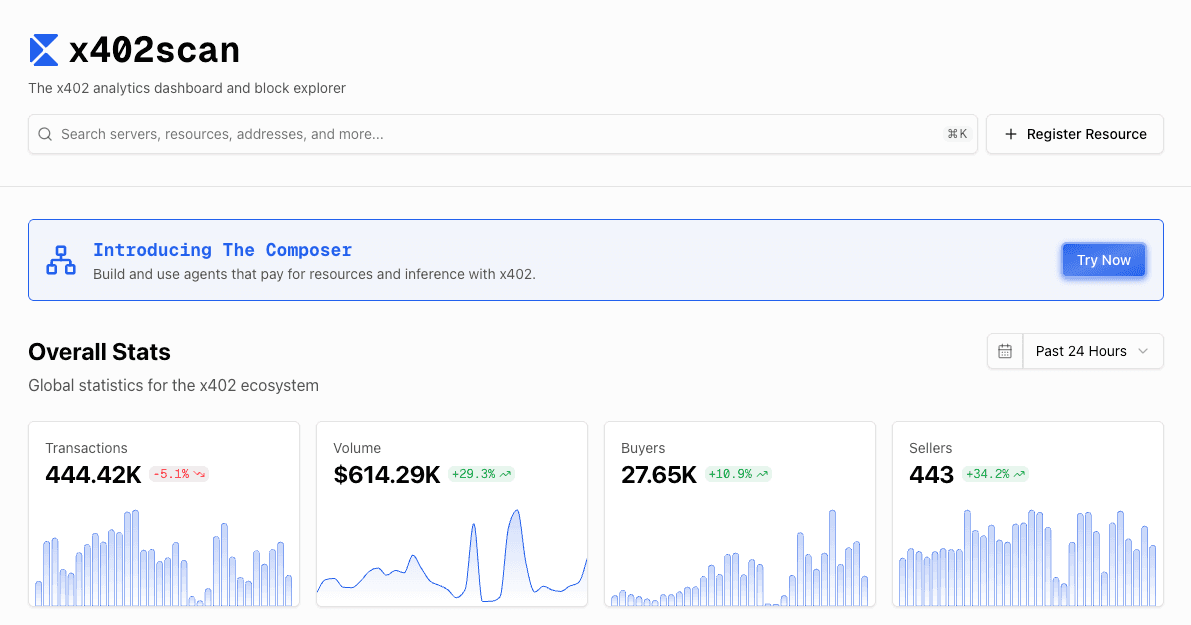
Monitor your transaction volume using the x402 ecosystem tools. Platforms like Bitquery offer real-time analytics for payment transactions, helping you track adoption and revenue. Keep an eye on gas fees and network congestion to ensure your pricing model remains viable for AI agents.
No comments yet. Be the first to share your thoughts!